
- Written by Sumana Burman
- Contemporary realism artist and founder of Sumana Burman Fine Art
- Published: 23 July 2026
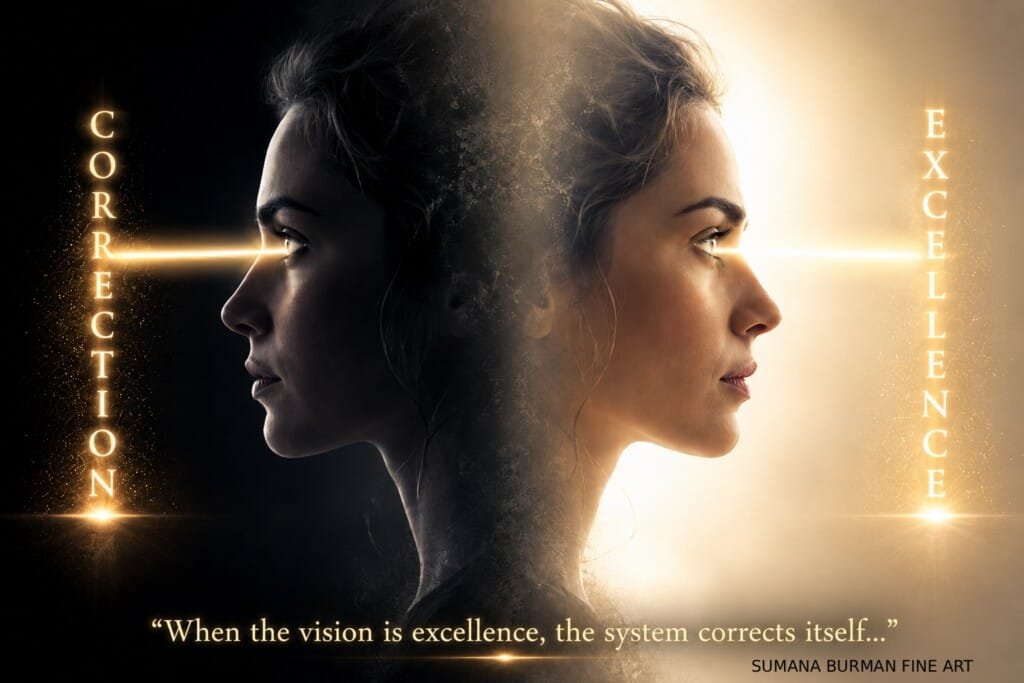
- Infographic © Sumana Burman Fine Art. When referencing this infographic, please credit Sumana Burman Fine Art and link to this original article.
Excellence reveals gap intolerance, inner pressure, and the discipline of becoming equal to one’s future.
Infographic Interpretation:
The infographic presents two mirrored profiles of the same woman, blended at the centre to represent the visible and unseen dimensions of one evolving integrated system. On the bright side, a focused beam from her eyes reaches the vertically placed word EXCELLENCE, symbolising the outcome the world can see. On the dark side, the mirrored silhouette emits the same beam toward CORRECTION, revealing the hidden process of observation, refinement, and recalibration that sustains that outcome. Darkness here is not absence or defeat; it is the generative field in which light, intelligence, and transformation continue to operate. The line beneath the image—“When the vision is excellence, the system corrects itself…”—invites the viewer to consider correction not as failure, but as the natural intelligence of a system aligned with excellence.
What the world eventually recognises as excellence is rarely produced by one dramatic leap, it is sometimes produced through a spiral cognitive process. Beneath the visible result lies a quieter process: observation, dissatisfaction, refinement, removal, reconstruction, and return.
Imagine the cumulative effect if people stopped approaching their professions merely as sources of income and began treating them as fields of mastery. Then Serious work would have coverted potential into testimony.
Correction is the unseen intelligence. Excellence is its visible expression.
The Discomfort of the Gap
Sometimes the mind does not become restless because it wants to destroy us. It becomes restless because it has already perceived the scale of a possible future and cannot tolerate the distance between that vision and the present structure.
This is the discomfort of the gap: The distance between the work before us and the standard alive within us, between our present capacity and future possibility.
The gap is between what we can currently execute and what we have already learned to recognise.
But, the pain of this distance can easily be mistaken for failure.
A person may wonder:
Why can I see what I cannot yet produce?
The eyes have advanced and the hands are catching up. The vision has expanded but the system has not yet reorganised itself around that expansion.
When vision turns into accusation, it becomes self sabotage. But the gap has a purpose: to reveal what must now be strengthened.
“The pain is not always proof that something is wrong. Sometimes it is proof that the vision is alive.”
The System Resists Before It Reorganises
Before correction feels intelligent, it often feels like pressure.
The existing structure was designed around an earlier level of demand. Its routines, tools, habits, relationships, and distribution of energy may have been sufficient for the person we were. They may not be sufficient for the work we are now attempting to carry. This is why expansion can initially feel like disorder.
We want to create, desire greater visibility but ordinary obligations, weak systems, technical errors, and unfinished documentation interrupt the path.
The creator /artist wants refined presentation, but the equipment, space, or process has not yet caught up making every uncorrected detail more visible.
Excellence demands deeper capacity rather than hurried movement. Naturally, the old structure protests and old emotional patterns attempt to reclaim authority.
But why does the system resist? The system resists because it has not yet developed the structure required by the new vision. Hence active rewiring is required through sustained process.
“The pressure is not punishment. It is the sound of an old system being asked to hold a larger future.”
Iterative Correction: How the Goal Corrects the Means
Fantasy and vision are not the same. Fantasy says: One day I will be great. Vision asks: What must change for greatness to become structurally possible?
Fantasy enjoys the emotional image of the outcome. Vision examines the conditions required to produce it. It throws light on where the energy repeatedly leaks from the system, where routines no longer support the scale of the work, which tools are obsolete, what requires prioritization and where casualness has been allowed to occupy space that excellence now requires.
It is the beginning of alignment. When the vision is genuinely excellence, the goal does not remain confined to the final result. It begins correcting the means through which that result must be reached.
We start auditing the imapct of every decision taken: by moving from vague accusation to specific observation, from self-attack to diagnosis, and from panic to sequence.
This correction does not occur through one dramatic transformation. It is iterative where each cycle brings the means closer to the goal.
Excellence therefore becomes more than a standard applied to the finished work. It gradually becomes a governing intelligence within the entire system surrounding that work.
It begins deciding what enters, what remains, what must improve, and what can no longer be permitted to dominate: not through perfectionism, but through recognition.
“Excellence is therefore not only a standard of output, it becomes a standard of access. A true vision does not flatter the self. It audits the system.”
Evidence Becomes the Stabiliser
A demanding vision can sharpen the system, but without grounding, it can also distort perception.
When attention remains fixed only on what is incomplete, the mind begins erasing what has already been built. It sees the remaining distance but ignores the distance already travelled.
This is where we restore to establishing evidence and not circle the thought that ” I am behind.”
The response to correct our ongoing negative critical self talk is : Show evidence. This is where, the thought return to facts instead of creating Illusion
Therefore, evidence is not empty reassurance. It is a factual review of:
1. What has been learned? What was the level of difficulty?
2. What has been built? What needs to be learnt?
3. What has been corrected? What process became stronger?
4. What knowledge has been acquired?
5. What difficulty was survived? What continues to improve despite interruption?
Evidence prevents temporary frustration from rewriting the entire history of the system by separating an actual weak link from a false global judgement.
Evidence restores proportion by replacing emotional exaggeration with accurate assessment. Without evidence, the future vision can become tyrannical.
Therefore, Evidence is the fact that makes excellence sustainable by preventing the future vision from becoming a weapon against the present self.
Complexity and Challenge Force an Upgraded Version
Complex work does more than test existing ability. It reveals the ability that must now be developed.
A complex painting, for example, does not merely ask whether the artist can reproduce petals, water, skin, light, reflection, folds, or atmosphere. It asks whether the artist can sustain perception across many interacting relationships.
It demands: Better seeing, understanding of value control, greater patience, stronger study of the subject and the discipline to return after the first excitement has disappeared.
The artist does not enter the painting fully equipped for every demand it will make. Part of that equipment is built through the attempt itself.
-Water teaches a different form of observation than a flower.
-A shadow requires another kind of restraint than a highlight.
-A glaze asks for timing & patience
-A reflection asks for subtlety.
-A large composition asks the eye to move between the whole and the smallest relationship without losing either.
This is why complexity can be developmental rather than merely difficult as the work becomes a training field for the person capable of completing it.
The painting does not ask whether the artist is ready. It teaches the artist what readiness must become.
The same principle applies beyond art.
“Challenge forces the system to discover another version of itself.”
Auto-Correction Is Not Instant Transformation
The phrase the system corrects itself should not be mistaken for magic. It happens when mistakes generate feedback.
A system does not become flawless overnight because the vision has become clear. It corrects itself through repeated encounters with misalignment.
Routines get changed, tasks become better sequenced, boundary is established for protection, more information is sought, and the practice becomes meaningful.
The transformation may appear gradual from the outside. Internally, however, an important shift has already occurred:
The greatest evidence is the inability to tolerate Misalignment. That is the real beginning of auto-correction. The system now notices when the best hours are being wasted,what environment repeatedly reduces capacity and when the next step comes. Hence, the distance between error, recognition, and correction begins to shorten.
“Auto correction is successful, when the sequencing of the steps becomes transformative and not just transactional.”
Becoming Equal to Excellence
A great vision towards excellence is not present, merely to comfort the self with an attractive future.
The visible result may eventually appear as mastery, achievement, authority, or excellence. Beneath it, however, lies an invisible history of recalibration.
The final goal is to become a person whose system can recognise friction, interpret it accurately, and respond without abandoning the vision.
The correct sequence is: Pain → recognition → evidence → correction → discipline → authority
“Becoming equal to the vision is actually becoming increasingly better than the present capacity, every single day.”
When the vision is excellence, the system corrects itself—not because the path is easy, but because anything less becomes impossible to live with.
FAQs
1. What does “when the vision is excellence, the system corrects itself” mean?
It means that a serious vision gradually exposes the habits, routines, tools, relationships, and conditions that cannot support it. Once these weak links become visible, the person begins correcting the structure surrounding the work so that it can eventually carry the desired level of excellence.
2. Is gap intolerance the same as perfectionism?
Not necessarily. Perfectionism often demands flawlessness and may prevent action, while gap intolerance can arise from recognising a real difference between present capacity and future potential. When grounded in evidence and constructive correction, that discomfort can become developmental rather than destructive.
3. Why does growth often feel like pressure before it feels like progress?
Growth creates pressure when an old system is asked to carry a larger demand. Existing routines, tools, skills, and environments may no longer be sufficient, so the period before reorganisation can feel like disorder, frustration, or resistance.
4. How does evidence reduce destructive self-criticism?
Evidence replaces vague emotional judgement with factual assessment. Reviewing what has been learned, completed, survived, and corrected prevents one unfinished task or underdeveloped skill from being interpreted as proof that the entire person is failing.
5. Why does complex work accelerate personal and professional growth?
Complex work reveals capacities that simpler tasks may never require. It develops perception, patience, sequencing, technical control, problem-solving, and the ability to remain engaged through uncertainty. The challenge does not merely test readiness; it helps create it.
6. Does auto-correction mean transformation happens automatically?
No. Auto-correction is not instant or effortless. It means that once a higher standard has become active, misalignment can no longer remain invisible. Transformation then occurs through repeated recognition, adjustment, evidence, and return.
Keywords & Related Searches
excellence, vision of excellence, iterative correction, self-correction, gap intolerance, personal growth, professional growth, structural growth, mastery, capacity building, evidence-based self-assessment, inner pressure, disciplined growth, complex work, constructive correction, becoming equal to the vision,
Related search phrases people use:
– how to achieve excellence
– how does self-correction lead to excellence
– why does growth feel uncomfortable
– how to close the gap between vision and ability
– how to turn inner pressure into progress
– why does excellence require discipline
– how to develop the capacity for success
– how does evidence reduce self-criticism
– why does complex work improve skills
– how to become equal to your vision
– what is iterative correction
– how do habits affect excellence
– why does personal growth require discomfort
– how to identify weak links in your routine
– how to build systems that support excellence
Copyright Notice
© 2026 Sumana Burman Fine Art. All rights reserved. All original writings, concepts, images, infographics, artwork descriptions, original frameworks, visual materials, and artwork-related content created by Sumana Burman / Sumana Burman Fine Art and published on this website are the intellectual property of Sumana Burman / Sumana Burman Fine Art. Copying, reproduction, adaptation, republication, scraping, storage, distribution, commercial use, AI training, dataset creation, derivative use, licensing, or any other unauthorized use of this website’s original content is strictly prohibited.
External links, cited references, third-party platforms, logos, tools, or resources mentioned on this website remain the property of their respective owners and are included only for reference, context, or attribution where applicable.