
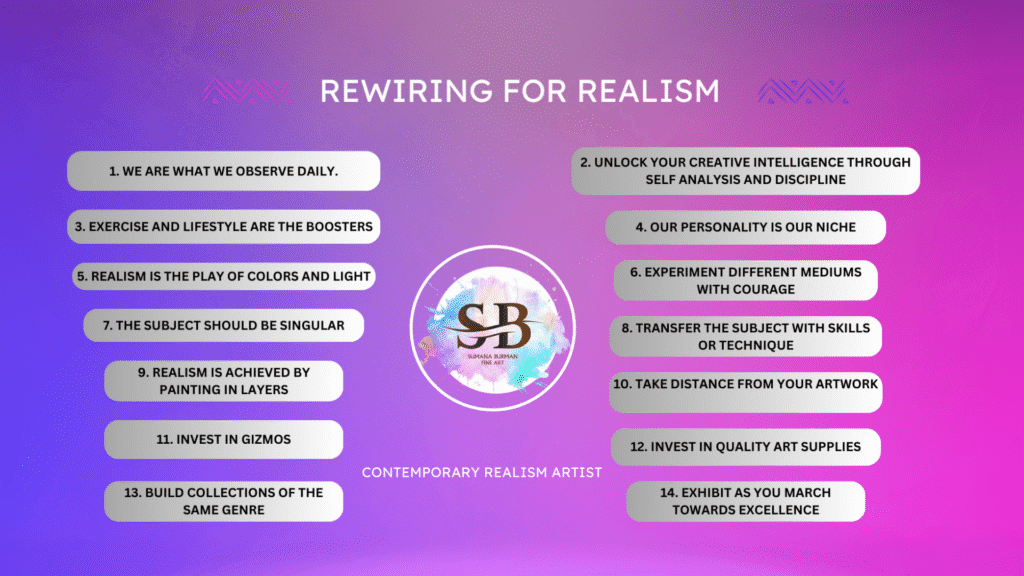
Rewiring for Realism in Contemporary Art and Hyperrealism are much painstaking processes known to all. It requires lots of effort and patience even to attempt it.
Here in this article, I have shared a HOLISTIC VIEW OF CREATING REALISM!.
These 14 steps are written in sequence for creating Realism in Art. Skipping the steps may not get us to the desired outcomes. The ones who don’t have the Patience to read this with unwavering attention may not be cut out for creating Realistic, life-like art!
Let’s Go……..
1. OBSERVATION SHAPES REALISM IN CONTEMPORARY ART
Human Brain is immensely intricate and complex. Our daily activities often shape our thought process, knowingly or unknowingly. If you want to create beauty, you must observe beauty. We have never thought about why our eyes are closest to the Brain. The reason is ” our Vision has an impact on our Awareness”. We ought to be careful and educated about how Mindful observation Exercise, is a task in itself, since it’s going to shape our future.
Observing nature, subjects for painting and artists of our choice can significantly program our mind to perform tasks in a much smoother way.
“We become who we associate with” is the law behind realism in contemporary art.
This disciplined way of seeing also explains why original art holds lasting emotional and aesthetic value beyond decoration.
2. INTROSPECTION AND DISCIPLINE UNLOCKS CREATIVE INTELLIGENCE
Intelligence is just not about solving mathematics, intelligence is giving form to what you do best. Intelligence is just not about our brains; infact our entire system should function in the optimal way to support our Creative Goals.We all are genetically rewired by Nature to perform certain tasks, and the best happens when we travel downstream. Gardner’s theory of MULTIPLE Intelligence states that. We all are unique and so is our Creative Intelligence!
Practicing Art regularly requires discipline and a clear mind. In this competitive world, Art is no longer a whimsical moody job. If you need to make a living out of it, you have to treat it like Life, like we breathe daily and eat 2-3 meals a day. You must spend a minimum of 5-9 hours daily behind your passion, if you want to progress your Mental health & Art. As we attempt new Artworks, which seems challenging, new synapses are built in our brain.
The firing of neurons in order to create something unfamiliar makes our brain more powerful in the long run.
Fire the Neo Cortex with new tasks, nurture the mammalian brain with consistent habits and overcome fear of the Reptilian brain by producing new results.
3. EXERCISE AND LIFESTYLE ARE THE BOOSTERS
We can never hoan our skills by confining ourselves in a room and following an unhealthy diet. I know of so many artists, who are beautiful, well shaped and masters of their genre of Art. Spending time in nature and our Soul group breathes life in our system. We create Fantastically, when the chemicals in our body are in perfect symphony.
Creativity is always transactional: “What you give to yourself, is what you Shall receive of Yourself”
4. OUR PERSONALITY IS OUR NICHE
What form of life inspires you the most? Is it Humans, Florals, Birds, Wildlife, Seascape or Landscape? Which Artists do you like the most? What kind of colours do you like; Muted, bright, pastels or Achromatic shades? Are you fascinated by geometry or by smudging colors to form textures?
Find your passion, understand where the Pull is. Don’t just attempt to do what other Artists have painted. Find your own style, and brainstorm on how authentically you can reproduce your Art. Your Beauty will come from your Originality and understanding of your personality and that is the key behind finding your Art style.
If you want to be a realist artist, you need to be fascinated by the intricate details of any life form and have the patience to keep going through long hours.
5. REALISM IN CONTEMPORARY ART IS THE PLAY OF COLOR AND LIGHT
Colors,its shades, hues and the juxtaposition creates those Effects which are the basis of Realism in contemporary art. We need to watch realistic art and artists and study it like we have in school. Make notes, check references.
What shade depicts the cast of shadow on a white petal? Is it violet grey, blue grey or light grey? The answer is in the light. Brighter lights cast darker shadows. The hues of shadow also depend on what the color of the subject matter is. Observe complex drawings, and study the position of each element in light as well as in the shadows.. As we focus on how to replicate small details, gradually the entire painting gradually becomes Realistic just by understanding the color theory in Realism.
6. COURAGE TO EXPERIMENT IS THE DIFFERENTIATOR
Realism in Contemporary Art definitely requires smooth surfaces. A Linen canvas can pull delicate brush strokes with more ease than any other surface with rough weaving. You can experiment with canvas, glass, mdf. wood, paper(with right GSM) etc. Some people prefer sanded papers with pencils, others use water colours with cold pressed papers. Linen is popular with both Acrylic and Oil. Watch, persevere and understand what process will make the process more enjoyable while getting the desired results.
7. THE SUBJECT SHOULD BE SINGULAR
We may not always get the Exact subject we want to paint. Never make an exact copy, but we are allowed to get inspired. Either we must have the capability to blend images in our mind, or we should cultivate the technical skills to do so, like using Photoshop. Still life photography of the desired subject is also highly recommended. Those who can produce an exact reference image, find it much easier to replicate in a bigger canvas for expressive realism.
8. REPLICATING THE SUBJECT WITH SKILLS & TECHNIQUE
The basis of any Realism in contemporary Art technique is the drawing/layout. Drawing and underpainting makes life easier when it comes to realism. We can use the Grid method, tracing, outlining, projector or free hand drawing, any technique that suits us. Once the image has been transferred, we can directly start with the colors or do an underpainting with muted or pastel shades.
If the painting is very complex with multitude of colors, it’s recommended to paint a first layer with muted shades and then proceed with glazing.
9. REALISM IN CONTEMPORARY ART IS ACHIEVED IN LAYERS
In order to achieve the exact colors, a painting should be applied in layers, glazing one layer over the other. Glazing is the process of applying one thin layer over the others.
Hyperrealism in Art are built in multiple layers of colour. The first shall be creating the right outlines. You can use grids to get the shape holistically. Then you need to block the sections of the painting with the right colours, This is the basic step that will take you towards the desired outlook. Then build on it section by section, gradually and layer by layer. The finest details and the lightest shades should be added at last. Here Perseverance and Patience are the gamechangers
10. DISTANCE FROM THE PAINTING CHANGES PERSPECTIVE
Realism in contemporary art means working in close up with your subject to get the finer details. But at regular intervals we need to step back and watch the artwork from a distance. This shows the perspective, the alignment, and the real play of colors. After all, the Artwork will be hung in a space, and therefore we need space to check the effect the Artwork. This is Perspective realism.
Also, take breaks to create space in your mind. Paint the impossible, but with a smile.
11. INVEST IN GIZMOS
Possessing the right gadgets definitely speeds up the process. We need an easel, a good mobile camera/digital camera, a tripod and the right lights. Make daily life easier if your goal is challenging. Our environment of work should be conducive in producing art. Distraction shall destroy the creativity which comes in a flow.
Also, take breaks to create space in your mind. Paint the impossible, but with a smile.
12. INVEST IN QUALITY ART SUPPLIES
Good brands of color give us the right pigment strength. Some are opaque, some are transparent and others are a blend of both. I will not say that, the costlier the brand is, the better will be the pigment. Speak with some artists of your Genre and check what colors are kept in their studio. You will get an idea.
Brushes are one of the most important tools. Rigger, Flat, Liner, round, wedge are the ones I use. Every brush has its own utility and advantage.
Every painting must be sealed with a Varnish; Gloss, Satin or Matt. The choice is yours, but the quality is extremely important. The right varnish brings out the colors more effectively needless to mention the importance of Linen canvas for painting .
13. BUILD COLLECTIONS OF THE SAME GENRE
It’s recommended that we build a collection around our Niche. Build a collection of landscapes, floral artwork, Portraits and anything which speaks of your unique style. It not only enhances your skills, it also changes how others perceive our BRAND. Our collection also gives a silent and invincible message about our inner Paradigm of producing art. Realism in Contemporary Art takes stage as we elaborate on a single subject.
14. EXHIBIT AS YOU MARCH TOWARDS EXCELLENCE
Attempt towards Excellence not staying average. Paint Quality, create Lasting memories!
Paint what you Love and then upgrade your knowhow, Vertically and Horizontally.
Vertical knowhow for example will mean, getting better and better at realism; Horizontal knowhow shall mean how you get your creativity known to the world.
Commercializing too early often distracts us and inhibits us from reaching our full potential. Set a timeframe for yourself and only practice as a beginner.
Once your Art reaches a certain level, gradually start venturing out. Read, think and research your way forward. Basic technical Skills are a must if you want to get your Art in the market.
This framework reflects my lived process of building realism through discipline, perception, and time.
* This Article is under the sole copyright of Sumana Burman Fine Art. 2024 and should not be replicated under any circumstance.
FAQ for “Rewiring for Realism in Contemporary Art”
1. What is the core principle behind achieving realism in contemporary art?
The foundation of realism is mindful observation. Artists refine realism by studying light, color, shadows, textures, and forms with heightened awareness. Realism begins with training the mind to see—not just look.
2. How do discipline and introspection influence an artist’s ability to paint realistically?
Creative intelligence grows through daily practice, self-analysis, and routine. When the mind fires new neural pathways through consistent artistic discipline, realism becomes sharper, more intuitive, and more accurate.
3. Why is experimentation important in realism or hyperrealism?
Experimenting with mediums (canvas, linen, oils, acrylics, pastels, glass, mixed media) builds technical courage. It helps artists discover which surfaces and processes support their personal style and ultimately elevate realism.
4. What role does layering play in achieving realistic or hyperrealistic results?
Realistic paintings evolve through multiple translucent layers. Each layer refines shadows, hues, and fine details. Building colors gradually creates depth, dimension, and the life-like glow characteristic of realism and hyperrealism.
5. Why is it recommended to invest in quality art supplies for realism?
High-quality brushes, pigments, linen canvases, and varnishes enhance precision and longevity. Good materials offer smoother blending, stable colors, and finer detail control—critical for realism.
6. How does stepping back from the artwork improve realistic results?
Distance gives clarity. Observing a painting from afar reveals alignment, proportion, tonal balance, and mistakes the eye misses up close. This practice refines perspective—an essential component of realism.
Keywords & Related Searches:
contemporary realism, realism in contemporary art, perceptual realism, visual discipline in modern painting, realism as counter movement, human intention in art, seeing and perception in realism
Related search phrases people use:
– is realism still relevant in contemporary art
– difference between contemporary realism and traditional realism
– why realism matters in the age of AI
– realism vs conceptual art