
- Written by Sumana Burman
- Contemporary realism artist and founder of Sumana Burman Fine Art
- Published: 22 June 2026
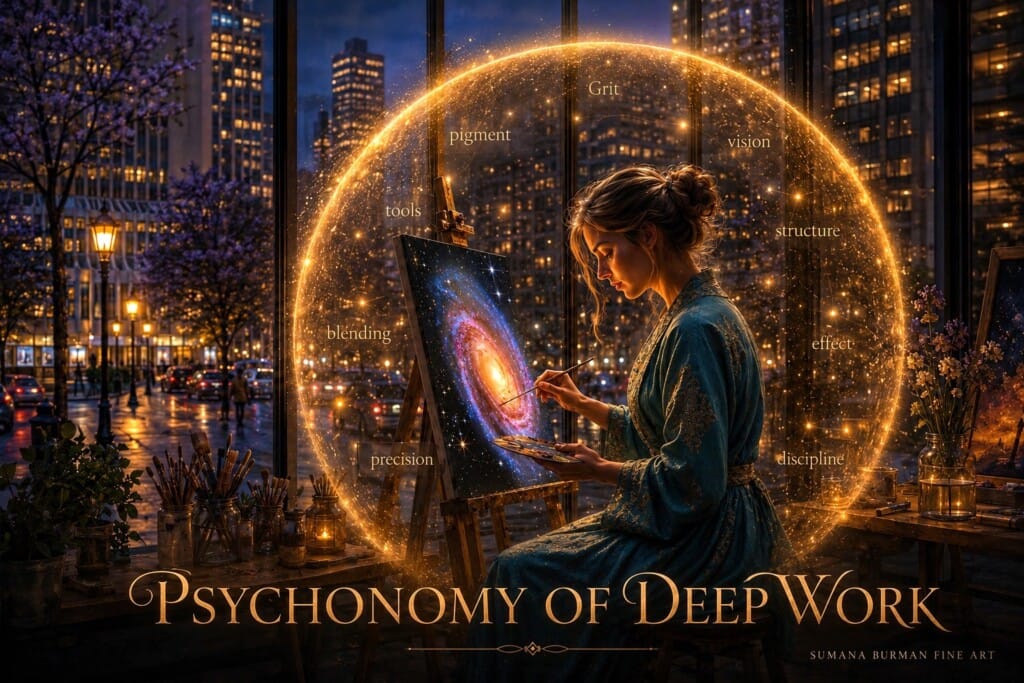
- Infographic © Sumana Burman Fine Art. When referencing this infographic, please credit Sumana Burman Fine Art and link to this original article.
Deep work does more than transform a painting; through sustained attention, correction, and repetition, it gradually transforms the artist as well.
Infographic Interpretation:
The infographic presents deep work as a protected sphere of sustained attention, separating the artist from the noise and movement of the surrounding city. Within this concentrated field, words such as vision, grit, pigment, precision, structure, blending, and discipline represent the forces guiding the creative process. The painting is not shaped by technique alone; it develops through repeated observation, correction and refinement.
At the same time, deep work changes the artist herself. Each decision strengthens perception, patience, judgement and artistic standards. The image therefore expresses the central idea of psychonomy: as the artist edits the work through deep work, the demands of the work gradually edit and reorganize the artist in return.
Deep work makes certain laws visible. When a person enters a demanding process repeatedly, the mind is not only using attention. It is being trained by attention.
A serious process leaves residue inside the practitioner. It changes what they notice, what they tolerate, what they repeat, and what they can no longer fake.
It is not only correcting the work. It is being corrected by the work.
The artist corrects the work, and repeated correction reorganizes the one who corrects. Gradually, the work begins correcting the artist.
Therefore, a serious process does not only produce work. It produces the worker.
What you edit edits you.
What Is Psychonomy?
Psychonomy refers to the study of the laws governing mental processes. Derived from the Greek words psyche, meaning mind, and nomos, meaning law, it seeks to understand the principles through which perception, attention, memory, inhibition, correction, and cognition shape human behavior.
But the mind is not a machine made of isolated parts. It does not simply perceive, then think, then act. As a result, these processes overlap, merge, correct one another, and form a living system.
For this reason, psychonomy must be understood not only through analysis, but also through synthesis. Analysis separates mental processes for study. Synthesis reveals how those processes work together as a whole.
Through this lens, we begin to understand how recursive work creates embodied intelligence, neural patterning, and refined perception—an idea explored further in When the Vision Is Excellence, the System Corrects Itself.
The Law of Reciprocal Editing
Every serious process has two outcomes.
The first is external: a painting, a manuscript, a design, a theory, a task, or a body of work.
The second is internal: a changed mind with enhanced motor precision.
A process that demands precision gradually changes the person who practices it. It reorganizes how attention is held, how errors are detected, how impulses are restrained, and how perception is refined.
The maker begins by shaping the work. Over time, the work begins shaping the maker.
Hence, this is the deeper psychonomy of process: repeated action becomes cognitive architecture.
Perception Against Assumption
Realism painting, for example, offers a powerful reference for this principle because it makes the correction loop visible.
The artist must repeatedly compare what is seen with what has been placed on the canvas. The eye observes. The mind evaluates. The hand adjusts. The canvas responds. The cycle begins again.
Therefore, this loop is not merely technical; It is cognitive.
The painter must learn to override assumptions. A face cannot be painted as the idea of a face. A flower cannot be painted as the memory of a flower. Water cannot be painted as the symbol of water. Each must be observed as a living arrangement of value, edge, color, proportion, temperature, and spatial relationship.
In this way, realism is not only a method of representation. It is a discipline of perception.
The Hand as Evidence of Deep Work
Several mental processes become active in any serious act of deep work.
Perceptual Discipline
The mind usually simplifies reality. It names things quickly and moves on.
Deep work resists this shortcut.
It asks the mind to look again, compare again, and refine again. Through repetition, perception becomes less automatic and more exact.
Inhibition of Shortcuts
Human cognition depends on shortcuts. These shortcuts help us function efficiently, but they can also prevent us from seeing clearly.
In a demanding process, the artist, writer, thinker, or builder must inhibit the first easy answer. The familiar symbol must be suspended so that the real structure can appear.
This inhibition is not suppression. It is refinement.
Attention Cycles
Deep work is not one long act of concentration. It is an oscillating rhythm moving between observation, execution, evaluation, correction, and renewed observation.
This cycling is what strengthens focus. Attention becomes less scattered because it is given a task with consequence.
Motor Translation
The hand is not separate from thought.
In painting, writing, music, design, and craft, the hand becomes the physical extension of perception. Enhanced motor action translates external data into form through pigment, structure, and feel.
The body becomes capable of producing a visible record of observed reality.
Inner Cleanliness Refines the Inner Standard
The cleaner the inner architecture becomes, the less the work has to carry unresolved noise.
The refinement of work is inseparable from the refinement of the worker. What remains is not perfection, but transparency — the capacity to let truth pass through without being bent by what is still unexamined.
Shadows do not only sit inside a person. They leak outward as exaggeration, avoidance, over-explanation, weak correction, and lifeless execution.
So when the inner field becomes cleaner, the work becomes less contaminated. Not because the artist becomes “perfect,” but because the artist becomes transparent enough for truth to pass through.
A scientist refining an experiment, a writer revising a sentence, a musician repeating a phrase, a designer adjusting a form, an athlete correcting movement, or a thinker refining an argument — all enter the same reciprocal field.
The process is editing the output.
The output is editing the mind.
Therefore, any serious process can become psychonomic.
The Process Outlives the Product
The deeper effect of the process is not only skill; it is the restructuring of the psyche.
A person who repeatedly practices correction becomes more sensitive to distortion, less ruled by distraction, and increasingly loyal to perceptual steadiness.
The macro and the micro patterns work synergistically to produce brilliance.
This is why deep work can feel difficult: it asks the older version of the self to be revised.
But if the practitioner stays, the process also builds a refined, elevated, and polished version of the practitioner.
Aftermath: The Visible Record of an Invisible Reordering
A completed work is evidence.
It shows what the practitioner was able to perceive, tolerate, refine, correct, and synthesize.
In this sense, deep work is not merely productivity. It is self-architecture produced through reciprocal editing.
The canvas, the page, the instrument, the body, the research, the discipline — each becomes a mirror of the mind’s evolving order.
And when the process is deep enough, the final work is not only something made.
It is something that metamorphosed the maker.
What you edit edits you.
FAQs
What does psychonomy mean?
Psychonomy refers to the study of the laws governing mental processes. It explores how perception, attention, memory, correction, and cognition shape human behavior.
What does “what you edit edits you” mean?
It means that a serious process does not only change the work being created. Through repeated correction, it also changes the person creating it.
Why is deep work important in art?
Deep work trains perception, patience, discipline, and correction. In art, it helps the artist move beyond assumption and see structure, value, color, and form more truthfully.
How does realism painting train the mind?
Realism painting forces the artist to compare observation with representation repeatedly. This creates a feedback loop between the eye, the mind, and the hand.
Can any process become psychonomic?
Yes. Any serious process that involves repeated observation, correction, and refinement can become psychonomic because it reshapes the practitioner over time.
Why does inner cleanliness matter in creative work?
Inner cleanliness reduces distortion. When unresolved noise, exaggeration, avoidance, and weak correction are refined, the work becomes clearer, stronger, and more truthful.
Keywords & Related Searches
deep work, psychonomy of deep work, psychology of deep work, deep work and the mind, sustained attention, recursive work, embodied intelligence, neural patterning, refined perception,
focus and discipline, inner structure, cognitive refinement, attention and mastery,
Related search phrases people use:
– what is deep work
– how does deep work change the mind
– how sustained attention shapes the brain
– why repeated practice improves perception
– how discipline changes the worker
– what is embodied intelligence
– how recursive work builds mastery
– how focus creates refined perception
– how editing changes the creator
– why deep work requires structure
– how attention becomes intelligence
– how the mind changes through repeated work
Copyright Notice
© 2026 Sumana Burman Fine Art. All rights reserved. All original writings, concepts, images, infographics, artwork descriptions, original frameworks, visual materials, and artwork-related content created by Sumana Burman / Sumana Burman Fine Art and published on this website are the intellectual property of Sumana Burman / Sumana Burman Fine Art. Copying, reproduction, adaptation, republication, scraping, storage, distribution, commercial use, AI training, dataset creation, derivative use, licensing, or any other unauthorized use of this website’s original content is strictly prohibited.
External links, cited references, third-party platforms, logos, tools, or resources mentioned on this website remain the property of their respective owners and are included only for reference, context, or attribution where applicable.