
- Written by Sumana Burman
- Contemporary realism artist and founder of Sumana Burman Fine Art
- Published : 28 May 2026
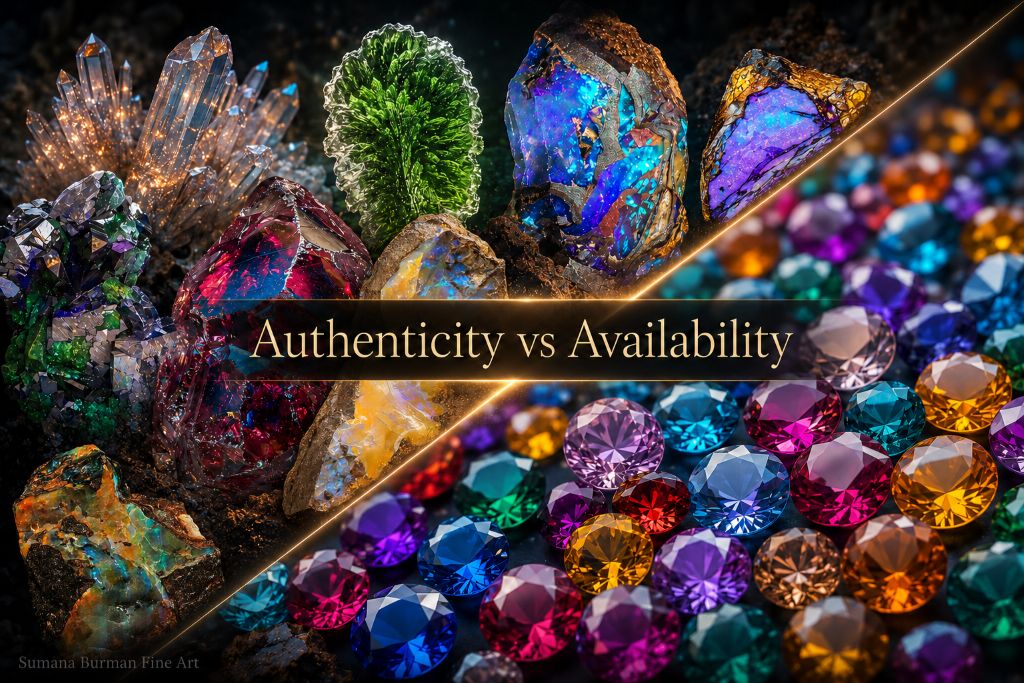
- Infographic © Sumana Burman Fine Art. When referencing this infographic, please credit Sumana Burman Fine Art and link to this original article.
Authenticity
For me, Signature Art is just not authenticity in art, something that is just handmade or original. Authenticity is formed through sustenance under pressure. Authenticity is what remains after an artist has resisted imitation, convenience, emotional laziness, public noise, market shortcuts, and the temptation to become more acceptable than accurate.
It is not only what the artist expresses; it is what the artist refuses to dilute and the refusal to let a painting remain weaker than its own possibility.
Infographic Interpretation:
This Infographic stages the central tension of the essay through two different forms of beauty. The raw crystals on the left evoke authenticity — a beauty shaped by pressure, irregularity, geological time, and inner structure, rather than by the demand to become easy or immediately consumable. It is like a once-in-a-lifetime formation — like a tangent touching an arc at one precise point, where pressure, timing, and structure meet. Therefore the polished gemstones on the right represent availability — bright, attractive, accessible, and market-ready, refined for visibility, repetition, and instant desirability, a very precise metaphor for availability.
Hence a signature artwork is a decision. Authenticity is the invisible authority inside a work of art, the unmistakable presence of the artist’s inner world — the part that cannot be copied, mass-produced, rushed, outsourced, or reduced to surface appeal.
“Simplicity is not the absence of complexity; simplicity is the resolved assimilation of complexity”
“Authenticity is not produced by polish alone; sometimes it is formed by impact, rupture, pressure, and rare alignment”
Availability
For me, availability is not a harmless word in the modern art world. It is one of the most dominant pressures placed on artists today. It carries the pressure of platforms, marketplaces, algorithms, and digital systems that ask artists to become constantly visible, constantly reachable, constantly adaptable, and constantly productive.
Digital platforms often promise exposure, growth, discovery, and opportunity, but they do not always offer equal accountability when reach disappears, rules shift, visibility is restricted, paid promotion becomes necessary, or the artist’s labor is reduced to content. They want access to the artist’s images, stories, audience, time, and trust, but the responsibility remains largely with the artist. As a result, availability must be handled with discipline.
As a result, signature art needs pathways of discovery, but it cannot be surrendered into uncontrolled access. It should be visible without becoming overexposed, searchable without becoming ordinary, purchasable without becoming negotiable at every level, and present online without being flattened into mass content. Availability should serve recognition, trust, and serious collecting — not platform dependency, extraction, disposability and exploitation
“Availability is the refined equation between the Artwork and its niche audience, where the perceptive expertise is embraced, not negotiated”.
The New Pressure on Artists
The modern artist is no longer asked only to create. The artist is asked to appear, explain, post, adapt, respond, optimize, translate, document, package, promote, and remain commercially awake across multiple platforms. Therefore, visibility has become almost inseparable from survival, but this visibility often comes with a hidden demand: the artist must become constantly available.
Hence, this creates a strange tension. The artwork may be born from silence, patience, distance, and deep internal discipline, but the digital world asks it to perform like content. It asks the artist to release fragments before the work is fully understood, to repeat presence before meaning has matured, and to convert authorship into constant accessibility. As a result for signature art, this pressure must be examined carefully.
Discoverability Is Not the Same as Overexposure
Discoverability is necessary. A brilliant piece of Signature Art must be findable, understandable, and trustworthy for the audience that is meant to receive it. Hence, a website, search presence, professional images, clear documentation, thoughtful storytelling, and collector-facing information are not dilution. They are part of the bridge between the artwork and its rightful audience.
Overexposure begins when that bridge becomes a marketplace of exhaustion. When the work is shown without context, repeated without depth, pushed without dignity, or adjusted endlessly for platform appetite, its presence weakens. As a result, signature art does not need to hide, but it cannot be scattered everywhere without structure. It must be discovered through alignment, not consumed through noise.
Why Signature Art Requires Distance
Distance is not arrogance. Distance is protection. Every serious artwork needs a certain space around it so that its presence can be felt, not merely seen. When everything is instantly explained, instantly accessed, instantly compared, and instantly negotiated, the artwork loses the atmosphere that allows perception to deepen.
Signature art carries more than image and therefore cannot remain powerful if it is treated as endlessly reachable material. It needs framing, restraint, and proportion. The viewer should be invited toward the work, but not allowed to reduce it to convenience.
Access, Perception and Controlled Availability
Access when intentional allows a serious viewer or collector to approach the artwork through proper information, professional presentation, transparent policies, and a clear path of purchase. It respects both the audience and the artist.
At any point, signature art can enter the digital world, but it must not lose command of its own positioning.
Collectors do not respond only to beauty. They respond to systems, clarity, professionalism, and the sense that an artwork carries a defined place in the artist’s larger vision. When availability is intentional it does not appear desperate for attention. As a result, it appears, properly held, purchasable, but not endlessly negotiable. Therefore, in signature art, perception is not created by exposure alone; It is created by the quality of access and controlled availability.
FAQs
1. What does authenticity mean in signature art?
Authenticity in signature art means tested authorship, where the artist’s vision, discipline, technique, and inner truth become inseparable from the work.
2. Why should signature art not be treated like mass content?
Signature art cannot be treated like mass content because its value depends on depth, rarity, authorship, and perception — not speed, volume, or constant consumption.
3. What is the difference between discoverability and overexposure in art?
Discoverability allows the right audience to find and understand the work, while overexposure weakens its presence through repetition, noise, and uncontrolled access.
4. How does controlled availability affect the value of an artwork?
Controlled availability protects the artwork’s dignity by making it accessible to serious collectors without making it casual, diluted, or endlessly negotiable.
5. Why do collectors respond to rarity, authorship, and artistic distance?
Collectors respond to rarity, authorship, and distance because these qualities create trust, presence, and the sense that the artwork belongs to a serious artistic vision.
Keywords & Related Searches
signature art, authentic original art, original artwork, original paintings, signed original painting, artist signature artwork, original painting vs print, handmade art vs mass-produced art, contemporary realism art, original art for collectors, original acrylic paintings, fine art by independent artist, buy original art online
Related search phrases people use:
– what is signature art
– what makes original art authentic
– original art vs prints
– handmade painting vs mass-produced art
– why buy original art instead of prints
– why original paintings are valuable
– how to identify authentic original art
– why artist signature matters in art
– signed original painting by artist
– buy original art online from independent artist
– original artwork for collectors
– contemporary realism original paintings
Copyright Notice
© 2026 Sumana Burman Fine Art. All rights reserved. All original writings, concepts, images, infographics, artwork descriptions, original frameworks, visual materials, and artwork-related content created by Sumana Burman / Sumana Burman Fine Art and published on this website are the intellectual property of Sumana Burman / Sumana Burman Fine Art. Copying, reproduction, adaptation, republication, scraping, storage, distribution, commercial use, AI training, dataset creation, derivative use, licensing, or any other unauthorized use of this website’s original content is strictly prohibited.
External links, cited references, third-party platforms, logos, tools, or resources mentioned on this website remain the property of their respective owners and are included only for reference, context, or attribution where applicable.