
- Written by Sumana Burman
- Contemporary realism artist and founder of Sumana Burman Fine Art
- Published: 27 April 2026
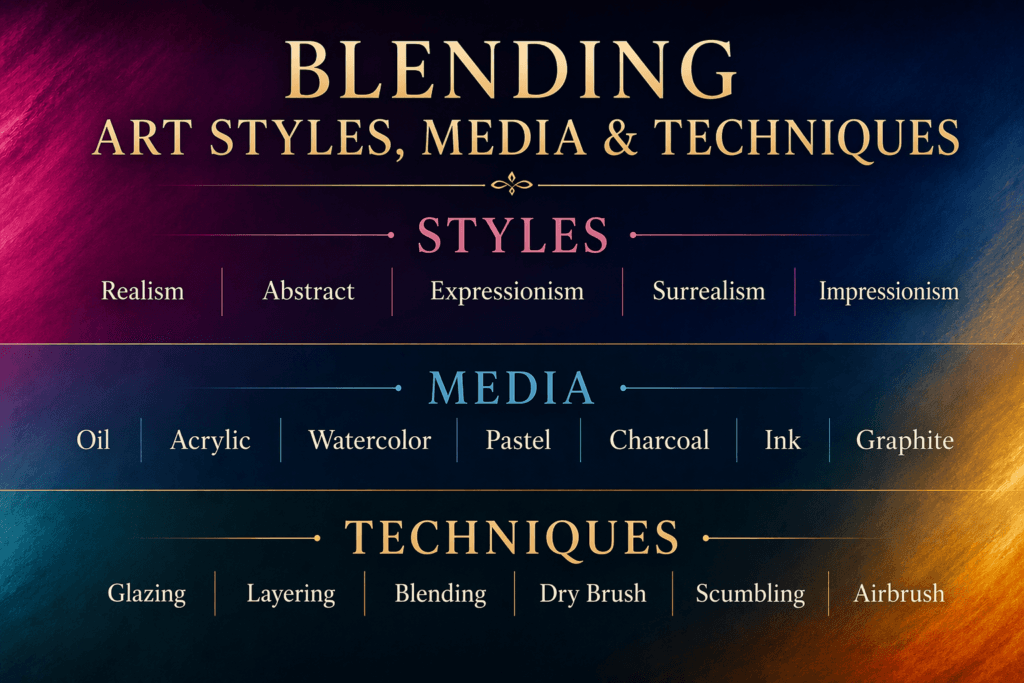
- Infographic © Sumana Burman Fine Art. When referencing this infographic, please credit Sumana Burman Fine Art and link to this original article.
Blending Media and Art Styles in Contemporary Art help us achieve the finesse that only a single media or a technique struggle to deliver.
Blending media and art styles in contemporary art is increasingly shaped by crossover rather than purity. Many artists no longer work within a single medium, method, or visual language alone. Instead, they combine drawing and painting, realism and atmosphere, structure and interruption, in order to build works that feel more layered, alive, and more responsive to the demands of the image itself without fragmenting the artwork.
Blended practice, at its strongest, is not random mixing or surface-level experimentation. When used with intention, these differences do not fragment the artwork. They expand its expressive and visual intelligence. Collectors today are not only interested in surface beauty; they are also becoming more conscious of material process, artistic intention, and the deeper value of buying original art
What are different art styles?
Art styles refer to the visual character or expressive language of a work rather than the material it is made from. Realism, abstraction, impressionism, expressionism, surrealism, minimalism, and hyperrealism are all examples of styles. A style shapes how the artwork handles form, colour, atmosphere, space, rhythm, and emotional tone; different from medium. Acrylic, oil, charcoal, pastel, graphite, airbrush, and ink are materials or media; realism, abstraction, and expressionism are visual languages or styles.
Here, distinction matters because artists often blend both media and style at the same time. A painting may remain fundamentally realist while borrowing the softness of impressionistic handling, the interruption of more expressive mark-making, or the compositional simplification associated with abstraction. That kind of crossover is increasingly common in contemporary art because artists are less interested in obeying a single category than in finding the most effective language for the work.
Once that is understood, blending media and art styles become easier to grasp. It is not only about what the artist uses, but also about how the artist chooses to see, structure, and resolve the image.
Why blended practice feels so relevant in 2026
Blending media and art styles feels especially current, because contemporary art is increasingly rewarding hybridity, crossover, immersion, and material intelligence rather than medium purity alone. The current cultural atmosphere is already layered: digital images, tactile longing, craft revival, architectural awareness, cinematic pacing, and a renewed appetite for texture and presence all coexist. It makes sense that artists are responding with equally layered forms of making. Instead of asking which single medium defines them, many artists are asking what combination of materials and methods can carry the work most fully.
A shift Away from Medium Purity, is also visible at the institutional level. Today museums and major programming that are foregrounding interdisciplinary, multisensory, textile-led, spatial, and materially diverse practices rather than rigid categories. It suggests that blending media and art styles is no longer a side experiment or niche exception, but part of how contemporary art now speaks.
From identity anxiety to material intelligence, artists become stronger when they stop demanding that one material solve every challenge. Charcoal thinks differently from a brushstroke. A pastel accent can breathe differently from a glaze. Effortless diffused transition can evoke something a hard-edged passage never could. Once that is understood, the question changes. It is no longer, “What medium do I belong to?” It becomes, “What does this work need?”
How media and methods interact in studio practice
In studio practice, blending media and art styles work rarely begins as chaos. It usually unfolds in layers, with each medium entering for a particular reason.
The first layer is often structural. Drawing materials such as pencil, charcoal, or ink may establish rhythm, placement, proportion, and spatial logic before color appears. This stage gives the artist something more intelligent than a blank surface: it gives the work an internal skeleton.
A second layer is often painterly or atmospheric. Oils establish tonal paradigm and glow. Acrylic may establish shape quickly, block in values, or create fast-drying passages that support later development with oil. Airbrushes may enter where diffusion, softness, atmospheric haze, or skin-like transitions are needed. These early or middle passages can determine whether the work feels rigid or alive. They help move the painting out of plan and into presence.
Often the third layer is selective and material-specific. Pastel may be introduced for bloom, tactile interruption, or edge vibration. Charcoal may return to recover structure or reassert clarity. Pencils may sharpen a contour, glazing restore delicacy, or add intimacy to a botanical transition.
Therefore, a slower, deeper medium like oils may then unify the whole, saturating the surface and pulling disparate passages into a coherent visual field. Over time, this also becomes a way of training the eye for realism, because the artist learns to separate structure, value, edge, atmosphere, and finish instead of treating them as one blurred task. This is where blending media and art styles becomes powerful: not when materials are piled together for novelty, but when each one solves a different visual problem.
Which materials actually work well together?
Not every combination is equally wise, especially if the work is meant to remain archival and saleable. But artistically, several combinations have proved highly effective because they bring different strengths to the same surface.
Charcoal and acrylic often work beautifully together in the early stages of a painting. Charcoal brings looseness, speed, and structural intelligence; acrylic brings rapid color development and shape control. This combination allows drawing energy to remain alive beneath more resolved layers as used in grisaille underpainting.
Pencil and acrylic can be especially effective in figurative realism, botanical work, and before the brush commits to form. It is useful where the artist wants more control without heaviness.
Airbrush and acrylic form a natural partnership when the work requires softness, diffusion, atmosphere, or near-photographic smoothness. Airbrush offers haze and subtle transition; acrylic offers speed and layered flexibility in drawing smoke, color transitions and light.
Acrylic and oil, when handled correctly, can also produce a powerful sequence. Acrylic establishes underpainting and early structure with speed, while oil can later deepen the image through slower chromatic modulation and more sustained surface development. One carries momentum; the other carries gravitas, and in combination a undeniable choice for botanical hyperrealism.
Oil pastel, over painted surfaces can reintroduce immediacy, broken color, sanded texture waxy resistance, or gestural energy into otherwise controlled passages. That kind of contrast can prevent a painting from becoming too uniform or too polished.
What matters most is not whether a combination is fashionable, but whether each material brings a distinct intelligence.
At a broader level, artists have also long crossed between art forms, not just media. Painting has borrowed from music, textile has taken on sculptural authority, installation has moved toward theatre and spatial experience, and contemporary exhibitions increasingly operate through immersive, multisensory environments.
Artists who show what crossover can do
Some of the strongest artists remind us that crossover is not new, even if it feels especially visible now. Wassily Kandinsky remains a foundational example of painting learning from music. His work was not a matter of mechanically mixing media, but of allowing one artistic logic to enter another. Rhythm, harmony, emotional force, and non-literal resonance shaped the structure of the image.
Sheila Hicks offers another powerful model. Her practice expanded textile beyond convention, allowing fiber to enter the territories of sculpture, design, and space. The importance of this is not merely material. It shows how a medium often associated with craft can gain monumental authority when handled with conceptual and spatial force.
Sonia Delaunay also remains significant for the way colour, pattern, abstraction, fabric, and design moved across disciplines without losing seriousness. Her example shows that an idea can travel between painting, textiles, and design while retaining coherence.
These artists matter here because they demonstrate a larger truth: blended practice is strongest when it is not random mixing, but translation. One visual intelligence enters another and expands what the work can become
A personal note on my own blending art style
For me, blending media and art styles is a practice, and not a matter of combining materials for novelty or effect. It is part of how I build presence, authority, and visual depth within realism itself . I am not interested in realism as mere replication but precision. All media comes with their unique visual advantages and as an artist I recognize and honor that. This is also why my painting process often begins with structure before moving into atmosphere, tonal refinement, and final visual resolution
My paintings often begin from structure: the image must hold its internal rhythm, proportion, and spatial coherence before it can fully open into color, atmosphere, or detail. From there, different methods enter according to what the work demands.
FAQs
What does blending media and art styles mean in contemporary art?
Blending media in contemporary art means combining different artistic materials, methods, or visual languages within one artwork or practice. This can include pairing drawing with painting, realism with atmospheric handling, or structured passages with more expressive interventions.
Why do contemporary artists blend media and methods?
Contemporary artists often blend media and methods because different materials solve different visual problems. One medium may offer speed, another precision, another softness, another depth, allowing the final work to become more layered and resolved.
Is blending media in art the same as mixed media?
Not always. Mixed media usually refers to artworks made with more than one material, while blended practice can also include the merging of methods, visual languages, or stylistic approaches. An artist may work in a blended way even if the final result remains visually unified rather than obviously mixed.
Can realism be combined with other art styles?
Yes. Realism can be combined with impressionistic softness, expressive mark-making, abstraction, or atmospheric handling without losing its core identity. Many contemporary artists use realism as a structural base while allowing other visual languages to deepen the work.
Which art materials work well together in painting?
Several materials can work well together when used with intention. Charcoal and acrylic, pencil and acrylic, airbrush and acrylic, and acrylic under oil are all examples of combinations that can support structure, atmosphere, speed, or depth in different ways.
Why is blended practice important in contemporary art?
Blending media and art styles is important because it reflects the material and visual complexity of contemporary culture. It allows artists to move beyond rigid categories and create work that feels more layered, responsive, and visually alive.
Does blending media make an artwork stronger?
It can, but only when done with discipline. Blending media strengthens an artwork when each material contributes something necessary, such as structure, luminosity, softness, or interruption, rather than being added for novelty alone.
How does an artist know when to combine different media?
An artist usually combines different media when one material alone cannot fully achieve what the work needs. The decision is strongest when it comes from the demands of the image rather than from trend or experimentation for its own sake.
Is blended practice a trend or a lasting direction in art?
Blended practice may feel especially visible now, but it is not merely a passing trend. Artists have long crossed between materials, disciplines, and visual languages, and contemporary art continues to expand that tradition in new ways.
How can blended practice support an artist’s individual style?
Blending media and art styles can deepen an artist’s style by allowing different methods to serve different stages of the work. Rather than weakening identity, it can make a practice more distinct when the materials are used with consistency, intelligence, and purpose.
Keywords & Related Searches:
blending media and art styles, mixed media in contemporary art, contemporary art styles, underpainting and glazing techniques , grisaille underpainting , layered painting techniques, airbrush and acrylic
Related search phrases people use:
– what is mixed media in art
– how do artists blend different media
– importance of underpainting
– can realism be enhanced using grayscale reference
– what is the effect of glazing
– why is mixed media important in contemporary art
Copyright Notice
© 2026 Sumana Burman Fine Art. All rights reserved. All original writings, concepts, images, infographics, artwork descriptions, original frameworks, visual materials, and artwork-related content created by Sumana Burman / Sumana Burman Fine Art and published on this website are the intellectual property of Sumana Burman / Sumana Burman Fine Art. Copying, reproduction, adaptation, republication, scraping, storage, distribution, commercial use, AI training, dataset creation, derivative use, licensing, or any other unauthorized use of this website’s original content is strictly prohibited.
External links, cited references, third-party platforms, logos, tools, or resources mentioned on this website remain the property of their respective owners and are included only for reference, context, or attribution where applicable.