
- Written by Sumana Burman
- Contemporary realism artist and founder of Sumana Burman Fine Art
- Published: 5 April 2026
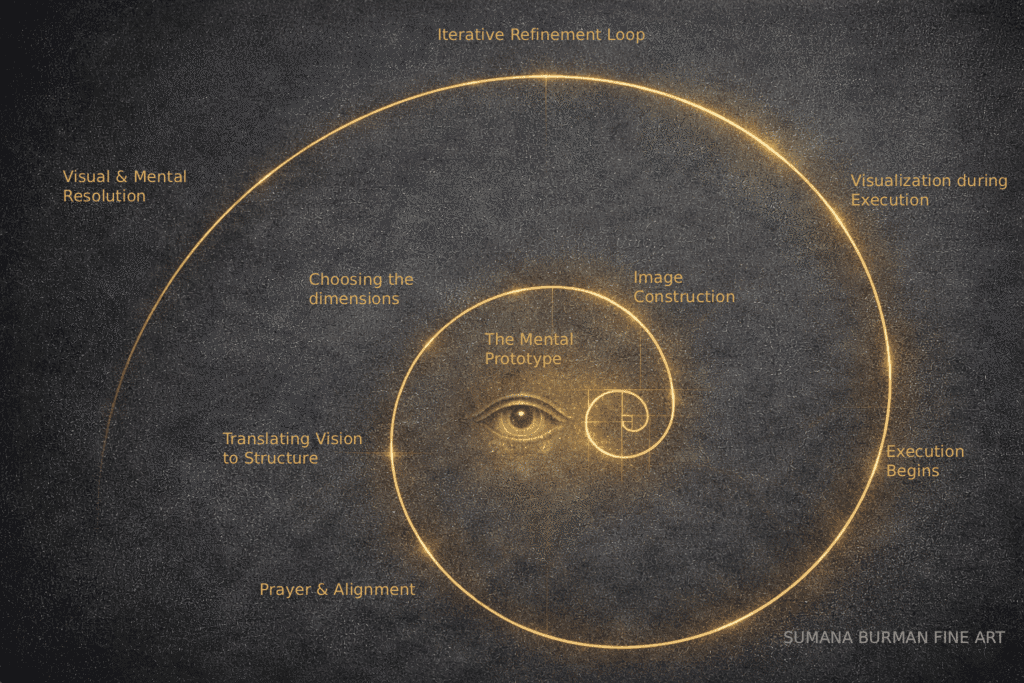
- Infographic © Sumana Burman Fine Art. When referencing this infographic, please credit Sumana Burman Fine Art and link to this original article.
A painting process begins long before the brush touches the canvas. In my practice, the process unfolds through a series of stages that move between imagination, structure, and execution.
It is not a straight line, but a spiral: each return to the painting sharpens the work further, until the internal vision and the physical image finally converge.
The Architecture Behind the Process
Painting is often described as spontaneous expression, but in reality it involves a complex interaction between imagination and structure. Research on the stages of the creative process in art also supports the idea that artistic development unfolds through multiple phases rather than a simple straight line
In my practice, the journey from vision to canvas is not linear. It is an evolving cycle where the painting gradually emerges through reflection, refinement, and persistence. What appears on the canvas is only one part of the deeper discipline of being a full-time artist, where vision, structure, and sustained inner labour all shape the final work.
Each work becomes the result of this ongoing dialogue between the mind, the image, and the canvas.
1. The Mental Prototype
The first stage is the emergence of a mental prototype.
This is not a finished painting yet, but an internal image where the subject, composition, and atmosphere begin to form together. Sometimes the vision appears quickly; sometimes it develops gradually.
The clearer this internal image becomes, the more decisively the painting process can evolve.
In this stage, the painting exists entirely in the mind.
2. Image Construction
Once the mental prototype appears, I begin refining it through image construction.
This may involve:
combining reference images
mentally stitching elements together
experimenting with visual possibilities through digital exploration tools
This phase functions like a visual laboratory where the concept gains clarity and structure.
3. Choosing the Dimensions
Scale is a crucial decision.
The size of the canvas determines not only the physical presence of the painting but also its compositional rhythm. Large-scale works require different spatial relationships and visual balance compared to smaller paintings.
For this reason, selecting the canvas size is part of shaping the visual authority of the work. Scale is not a secondary decision in the painting process; it shapes the force, rhythm, and spatial presence of the image.
4. The Grid: Translating Vision into Structure
After the scale is determined, the image must move from imagination to measurable space.
The grid becomes the bridge between imagination and measurable space. It allows the internal vision to be translated into proportion, placement, and structure on the canvas. The choice of dimensions is never incidental, because scale influences rhythm, embodiment, and the authority of large-scale realism within the viewer’s experience.
Through the grid, the painting process gains its structural foundation.
5. Prayer and Alignment
Before execution begins, I pause for a moment of prayer or quiet focus.
This is not a ritual of technique but of intention. It allows the mind to settle and align with the work that is about to unfold.
Painting requires attention, patience, and presence. This brief pause prepares the mind for the long concentration ahead.
6. Execution Begins
With structure in place, the painting process begins.
The early stages involve drawing, establishing tonal relationships, and building form. From there, the painting develops through layers of color, surface adjustment, refinement, drawing, tonal structure.
At this stage the canvas begins responding to the original vision.
7. Visualization During Execution
Even during the painting process, the mind continues to visualize the completed work.
This internal image acts as a compass, guiding decisions about light, color, balance, and atmosphere. To paint in this way also requires gradually rewiring perception for realism, because realism is not only a style of rendering but a trained way of seeing.
The painting is constantly compared with the mental prototype, and adjustments are made accordingly. The internal image does not disappear once painting begins. It remains active throughout execution, guiding decisions about light, color, proportion, and atmosphere.
8. The Iterative Refinement Loop
Rather than moving forward in a straight line, the painting progresses through repeated cycles of execution, assessment, correction, and refinement.
Instead it becomes a repeating cycle:
execution → visualization → correction → execution
This loop continues until the painting reaches a point where the internal vision and the physical image on the canvas finally converge. This is why my method does not unfold mechanically from start to finish, but through the recursive movement of non-linear thinking in art, where perception, revision, and intuition continue to inform one another.
Only then does the work feel complete.
9. Resolution
FAQs
1. How does a painting begin before anything is placed on the canvas?
A painting often begins as an internal image. Before execution starts, the subject, composition, atmosphere, and visual direction may begin forming mentally. This early stage shapes how the work later develops on the canvas.
2. What is a mental prototype in painting?
A mental prototype is the initial internal image of the painting. It is not yet the finished artwork, but a conceptual and visual form in which subject, composition, and mood begin to emerge together.
3. Why is canvas size important in the painting process?
Canvas size affects the rhythm, spatial balance, and physical presence of a painting. Scale is not only practical; it influences how the composition is experienced and how much visual authority the final work carries.
4. Why do artists use a grid before painting?
A grid helps translate an imagined or referenced image into measurable proportions on the canvas. It creates structural accuracy and supports the correct placement of forms, relationships, and scale.
5. Why is visualization important while painting?
Visualization allows the artist to keep the finished work in mind during execution. It guides decisions about color, light, balance, atmosphere, and correction throughout the painting process.
6. Is painting a linear process or an iterative one?
In many serious painting practices, the process is iterative rather than linear. The work evolves through repeated cycles of execution, observation, adjustment, and refinement until the image resolves.
7. How do imagination and structure work together in painting?
Imagination provides the internal vision, while structure gives that vision form. Tools such as references, scale decisions, grids, tonal planning, and refinement help translate an internal image into a finished painting.
8. When does a painting feel complete?
A painting feels complete when the physical image on the canvas fully aligns with the artist’s internal vision and no further correction feels necessary.
Keywords & Related Searches
painting process, artist painting process, creative painting process, artistic process, non-linear painting process, realism painting process, structure behind the artist’s process, how a painting evolves
Related search phrases people use:
– what is a painting process
– how does a painting process begin
– what are the stages of a painting process
– how artists move from idea to canvas
– why painting is a non-linear process
– how realistic paintings are created
Copyright Notice
© 2026 Sumana Burman Fine Art. All rights reserved. All original writings, concepts, images, infographics, artwork descriptions, original frameworks, visual materials, and artwork-related content created by Sumana Burman / Sumana Burman Fine Art and published on this website are the intellectual property of Sumana Burman / Sumana Burman Fine Art. Copying, reproduction, adaptation, republication, scraping, storage, distribution, commercial use, AI training, dataset creation, derivative use, licensing, or any other unauthorized use of this website’s original content is strictly prohibited.
External links, cited references, third-party platforms, logos, tools, or resources mentioned on this website remain the property of their respective owners and are included only for reference, context, or attribution where applicable.