
- Written by Sumana Burman
- Contemporary realism artist and founder of Sumana Burman Fine Art
- Published: 9 February 2026
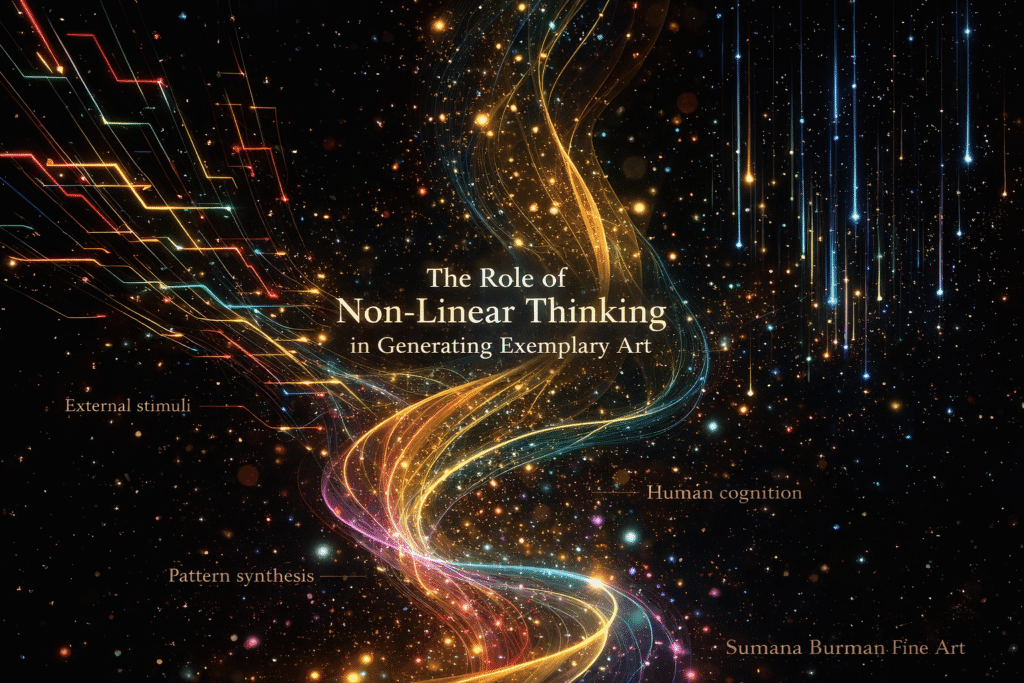
- Infographic © Sumana Burman Fine Art. When referencing this infographic, please credit Sumana Burman Fine Art and link to this original article.
Non-Linear Thinking is rarely named in discussions about art. Yet it quietly determines whether a work feels assembled or resolved.
Infographic Interpretation:
The infographic visualizes non-linear thinking as a dynamic movement rather than a straight sequence. External stimuli enter from different directions, carrying fragments of colour, experience, knowledge, instinct and observation. Instead of being processed one after another, these influences converge, separate, return and combine within human cognition.
The luminous central flow represents pattern synthesis—the point where apparently unrelated information begins to form a coherent structure. The image therefore shows how exemplary art can emerge through association, intuition and repeated recombination rather than through a rigid step-by-step method. Non-linear thinking transforms scattered inputs into an integrated artistic vision that feels resolved rather than merely assembled.
Most people assume that great art is the result of mastery, discipline, and repetition. In reality, what separates exemplary art from competent work is not how much an artist repeats — but how they think while working.
This difference is subtle, often invisible, and rarely named. Yet it determines whether a work merely functions, or whether it feels inevitable. That movement from scattered perception toward an integrated visual resolution can be seen in CHROMATIC RESOLVE, where contrasting hues and organic forms are brought into a unified composition.
Non-Linear Thinking, as Lived in the Studio
Many discussions frame Non-Linear thinking as a psychological trait or a cognitive style. In practice, inside the studio, it feels much simpler — and much less academic.
It looks like seeing relationships rather than sequences.
This means holding multiple timelines at once: where the work began, where it is now, and where it must arrive — without forcing a straight path between them.
It allows intuition and structure to coexist, instead of competing.
Progress happens through integration, not steps.
The artist does not move forward by completing stages in order. They move forward by resolving tensions as they arise.
This is not chaos. It is a different form of order.
Linear and Non-Linear Approaches to Making Art
The distinction becomes clearer when placed side by side.
A linear approach to art-making often looks like this:
Improvement through repetition
Method leads to result
Thinking happens in stages
Problems are addressed after they appear
A non-linear approach looks different:
Improvement through synthesis
Outcome and uncertainty are held together
Thinking happens in fields, not steps
Imbalance is sensed before it becomes visible
Neither approach is morally superior. But they produce very different kinds of work.
One optimizes execution. The other resolves structure.
Why This Produces Exemplary Art
Non-linear thinking allows artists to solve visual problems before they announce themselves.
Proportions are adjusted before they feel wrong.
Color relationships settle before dissonance appears.
Composition resolves internally, rather than being corrected later.
The result is work that feels coherent rather than assembled. Alive rather than arranged.
This is why exemplary art ages well and gives original art lasting value. It does not rely on trend, surface appeal, or immediate harmony. Such uniqueness holds together over time, because it was resolved from within.
Collectors often respond to this instinctively. Even without technical language, they recognize when a work feels complete — not finished, but inevitable.
In scientific terms, this kind of behavior is often described through the framework of nonlinear systems, where outcomes are not proportional to inputs.
How Contemporary Collectors Read This — Even Without Language
Contemporary collectors are not only buying objects. They are responding to resolutions.
In an age of visual excess, rapid production, and algorithm-driven imagery, collectors have become acutely sensitive to work that holds together beyond surface appeal. They may not name non-linear thinking, but they recognize its effects immediately. Such works remain legible over time, even as contexts shift. Studies of visual perception describe this sustained clarity.
Art enthusiasts notice when a painting does not explain itself — yet remains legible.
When every decision appears necessary rather than decorative.
When nothing feels added to impress, and nothing feels missing.
Work generated through non-linear thinking carries a particular signal: it does not seek validation from trend, theory, or narrative framing. It stands on internal coherence.
For collectors, this matters deeply.
Such works integrate more easily into long-term collections. They remain relevant as contexts change. They do not exhaust themselves after first viewing. Instead, they continue to disclose structure over time.
This is why collectors often return to certain artists — not because the work is louder, but because it stays resolved.
The Cost of Thinking This Way
Systems that measure value by output rather than coherence frequently misunderstand non-linear thinkers
From the outside, their process can look inconsistent or chaotic. Progress may not follow predictable timelines. Output does not always conform to systems designed for linear productivity.
They may struggle in environments that reward speed over resolution, or volume over coherence.
Acknowledging this cost matters. Without it, the discussion becomes romanticized. Exemplary work is not produced without friction — internal or external.
A Quiet Conclusion..
Exemplary art is not louder or trend-aligned, and it does not need explanation. It is resolved.
Non-linear thinking is not a claim of identity or superiority. It is simply the mechanism that allows an artist to arrive at that resolution — quietly, precisely, and without force.
Frequently Asked Questions
Is non-linear thinking the same as working without structure?
No. Non-linear thinking does not reject structure — it reorganizes it.
The structure exists simultaneously rather than sequentially. Decisions are made by sensing relationships between elements, not by completing steps in order.
Does non-linear thinking mean the artist works intuitively without discipline?
No. Discipline remains essential. The difference lies in how discipline is applied.
Instead of repeating methods, non-linear artists discipline perception — adjusting decisions in real time to maintain internal coherence.
Can non-linear thinking be learned, or is it innate?
It is not a personality trait or an identity.
Some artists arrive at it through experience, others through necessity. What matters is not origin, but whether the artist can integrate intuition and structure without separating them.
How does non-linear thinking affect the longevity of artwork?
Work created through non-linear thinking tends to age well because it is internally resolved.
It does not rely on trend alignment or surface harmony, allowing it to remain coherent as visual contexts change.
Why do collectors respond to non-linear work even without knowing the term?
Collectors respond to resolution.
They recognize when a work holds together without explanation, when decisions feel necessary rather than decorative. Non-linear thinking produces this effect, even if it is never named.
Is non-linear thinking relevant only to contemporary art?
No. It can appear in any period.
What makes it contemporary is not the technique, but the context — today’s visual saturation makes internal resolution more perceptible, and more valuable.
Why is the process of non-linear artists often misunderstood?
Because many systems are built to measure output, not coherence.
Non-linear processes may appear inconsistent from the outside, even when the work itself is highly resolved.
Does non-linear thinking make art harder to interpret?
Not harder — quieter.
The work does not announce its logic, but it remains legible. Interpretation unfolds through observation rather than instruction.
Keywords & Related Searches:
non-linear thinking in art, exemplary art, contemporary art thinking, artistic decision making, creative cognition in art, perception in art making, structure and intuition in art, visual coherence in contemporary art
Related search phrases people use:
– how do great artists think
– what makes art feel resolved
– difference between good art and great art
– why some artworks feel complete
– how artists make decisions while painting
– why some art ages better than others
– what collectors look for in contemporary art
– how to evaluate original artwork
Copyright Notice
© 2026 Sumana Burman Fine Art. All rights reserved. All original writings, concepts, images, infographics, artwork descriptions, original frameworks, visual materials, and artwork-related content created by Sumana Burman / Sumana Burman Fine Art and published on this website are the intellectual property of Sumana Burman / Sumana Burman Fine Art. Copying, reproduction, adaptation, republication, scraping, storage, distribution, commercial use, AI training, dataset creation, derivative use, licensing, or any other unauthorized use of this website’s original content is strictly prohibited.
External links, cited references, third-party platforms, logos, tools, or resources mentioned on this website remain the property of their respective owners and are included only for reference, context, or attribution where applicable.