
Botanical Hyperrealism in Contemporary Art: Detail, Scale & Emotion
An in-depth guide exploring botanical hyperrealism as a contemporary art form—where precision, scale, and emotional storytelling converge.
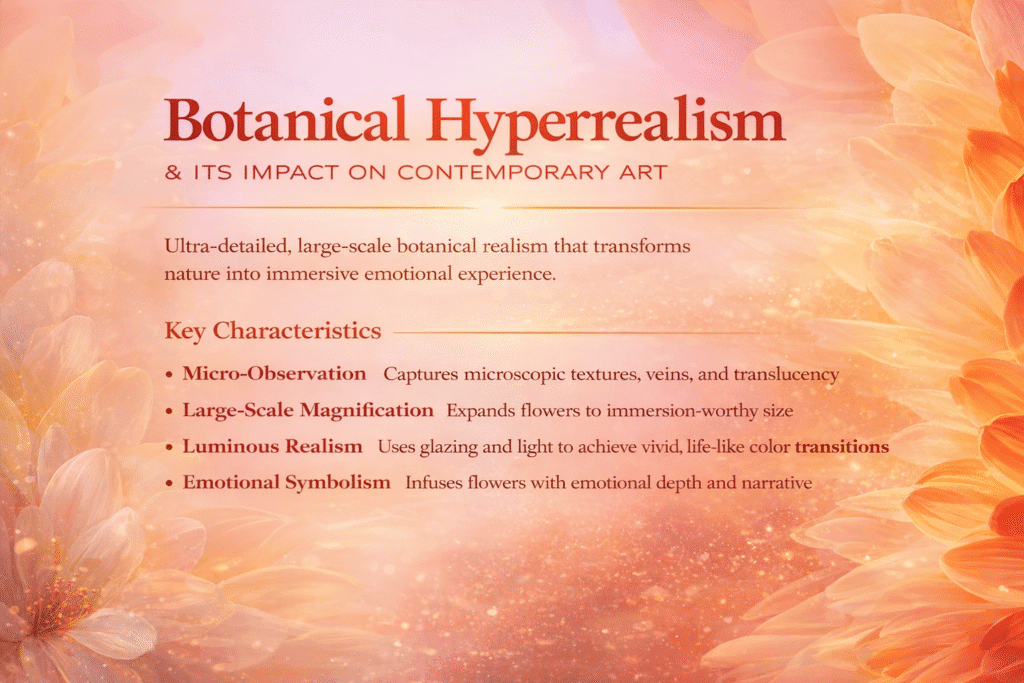
Botanical Hyperrealism is the art of transforming nature’s smallest details into large, breathtaking visual experiences. It is more than accuracy — it is the devotion to seeing beyond what the eye normally perceives. Through layered realism, microscopic observation, and emotional intentionality, botanical hyperrealism turns flowers, leaves, and natural forms into powerful visual narratives.
For many artists, this sensitivity to nature is also tied to emotional transformation explored in “From Wounds to Wonders: The Alchemy of Emotion in Art.”
In contemporary art, this emerging genre is reshaping how we understand beauty, precision, and emotional depth. As a result, Botanical Hyperrealism does not merely replicate nature — it reveals it.
How to Decipher Botanical Hyperrealism?
Botanical hyperrealism is a form of realism that focuses on:
-
- Ultra-fine detail
-
- Photographic accuracy
-
- Luminous color transitions
-
- Microscopic textures
-
- Large-scale magnification
Where traditional botanical art documents plants scientifically, hyperrealism elevates them emotionally and aesthetically. To summarize, its an art form that combines-Realism (accuracy of form), Micro-observation (textures, veins, translucency), Contemporary techniques (glazing, high-contrast lighting, color depth) and Emotional storytelling (energy, symbolism, mood). It transforms a flower from an object into an experience.

Key Characteristics of Botanical Hyperrealism
Extreme Detail & Magnification
Every petal vein, pollen grain, and translucency is rendered with precision normally visible only through macro photography.
Large Formats for Immersion
Canvases such as 48″ × 36″ or 48″ × 29″ allow the viewer to “enter” the flower.
Emotional Color Storytelling
Colors are not just literal — they represent energy, mood, and psychological impact.
Photographic yet Poetic
The artwork sits between reality and heightened perception, feeling alive, breathing, luminous.
Botanical Hyperrealism Vs Floral Realism & Botanical Art
Difference between floral realism vs botanical art
| Genre | Focus | Purpose | Style |
|---|---|---|---|
| Botanical Art | Scientific accuracy | Documentation | Flat lighting, measured drawing |
| Floral Realism | Aesthetic beauty | Decorative or expressive | Realistic but not microscopic |
| Botanical Hyperrealism | Ultra-detail + magnification | Emotional + immersive impact | Photographic + luminous + symbolic |
Hyperrealism is not just a visual style — it is an experiential state.
Botanical Hyperrealism Matters in Contemporary Art
-It Reawakens Emotional Connection to Nature
Viewers rediscover awe, intimacy, and reverence for the natural world.
-It Invites Mindfulness & Contemplation
Large blooms act like portals, slowing the mind and deepening presence.
-It Merges Art, Psychology & Symbolism
Botanical Hyperrealism is a convergence of Colors, textures, and forms carry emotional codes hence a symbol of passion, resilience, purity, sensuality, remembrance.
-It Creates Interior Masterpieces
Collectors use hyperrealism as statement pieces for luxury spaces, galleries, and hotels hence its Alchemical.
– It Represents Inner States, Not Just Flowers
Botanical Hyperrealism artists use petals and stems to depict endurance, femininity, divine beauty and transformation through grief. Therefore, the canvas becomes a mirror of the inner world. This emotional and aesthetic depth also explains why original handmade art holds lasting meaning beyond decoration.
This level of perceptual discipline and technical training is explored in depth in “Rewiring for Realism in Contemporary Art
FAQ
1. What makes botanical hyperrealism different from standard realism?
Hyperrealism magnifies details beyond normal perception, creating immersive, life-size or larger-than-life compositions.
2. Why is it popular among contemporary collectors?
It blends luxury, emotional depth, scientific detail, and mindfulness ; hence making it ideal for premium interiors.
3. What techniques are used?
Layering, glazing, controlled lighting, micro-texture rendering, therefore high-color-depth transitions.
4. Is it only about flowers?
No. Leaves, stems, seeds, bark patterns, and botanical structures can all be hyperrealistic subjects. As a result, its an aligned ecosystem.
5. How long does it take to complete a botanical hyperrealistic painting?
Botanical hyperrealistic paintings require extensive perceptual training, disciplined observation, and long-term technical refinement. Depending on scale and complexity, a single artwork can take anywhere from 50 to 300+ hours to complete.
6. What are the other forms of Botanical Art?
Botanical art exists in several forms, including scientific botanical illustration (focused on accuracy and documentation), traditional botanical realism (aesthetic representation without extreme magnification), decorative floral art, and conceptual botanical abstraction. Botanical hyperrealism sits at the intersection of science, realism, and emotional storytelling.
Keywords & Related Searches
botanical hyperrealism, botanical realism in contemporary art, hyper realistic floral paintings, contemporary botanical art, realism in floral painting, symbolism and precision in botanical art
Related search phrases people use:
– what is botanical hyperrealism
– difference between botanical art and decorative florals
– is botanical realism considered fine art
– why flowers are powerful subjects in contemporary painting
Copyright Notice
© 2026 Sumana Burman Fine Art. All rights reserved. All original writings, concepts, images, infographics, artwork descriptions, original frameworks, visual materials, and artwork-related content created by Sumana Burman / Sumana Burman Fine Art and published on this website are the intellectual property of Sumana Burman / Sumana Burman Fine Art. Copying, reproduction, adaptation, republication, scraping, storage, distribution, commercial use, AI training, dataset creation, derivative use, licensing, or any other unauthorized use of this website’s original content is strictly prohibited.
External links, cited references, third-party platforms, logos, tools, or resources mentioned on this website remain the property of their respective owners and are included only for reference, context, or attribution where applicable.